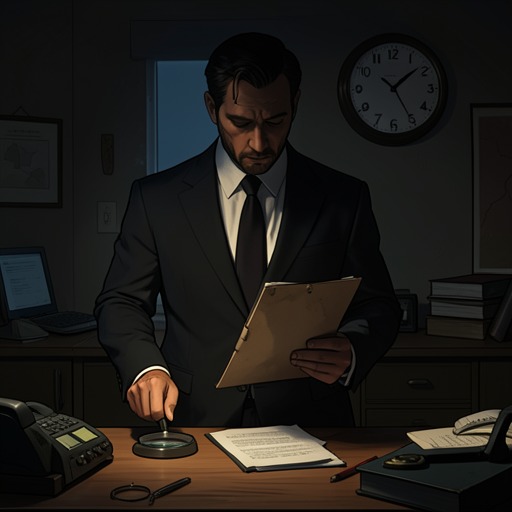
Ransom discovers his birth parents
Lost and FoundRansom discovers his birth parents when an ethically compromised bargain gives him access to the confidential records of Bethany’s agency. The discovery resolves the central uncertainty of his adopted identity: he learns that his birth name was Patrick Cartwright, that Genevieve Cartwright and Alexander Cartwright were his biological parents, and that the records of his early life contain both a history of abandonment and evidence of circumstances the adoption files cannot fully explain.
Causes and the Access Bargain
Ransom’s search begins long before the database scene. His parents had adopted a child through the agency where Bethany worked, but the adoption was closed, leaving him without the names or accessible records needed to reconstruct his origin. Public-record searches had failed because he did not know the name under which the records might be filed, while much of the relevant paperwork was held by the agency rather than by the state. The passage of roughly twenty years also raised the possibility that some court documents had been destroyed. What Ransom knew was therefore sharply limited: he knew he had been adopted, but not who he had been before adoption or what had happened to his birth family.
That uncertainty drives the bargain through which the discovery becomes possible. Ransom offers to pretend to be Bethany’s boyfriend, even escalating the offer to marriage, in exchange for secure access to agency files. He refuses to explain the full purpose of the request, calling it his business, while Bethany recognizes that the information is confidential. The arrangement is therefore not merely a romantic deception or a practical exchange of money; it places Ransom’s private identity search inside a transaction that risks Bethany’s employment and access privileges.
Bethany initially has reason to distrust the arrangement. After paying both restaurant checks, she reflects on the consequences of allowing a stranger to stay at her parents’ house, pose as her boyfriend for a long weekend, and receive access to confidential work information. She nevertheless accepts the risk because Ransom will help create the impressive public image she wants at her reunion, and because she believes she can still pay him instead if he proves untrustworthy. The later access is made possible by the trust and circumstances of their snowbound stay: Bethany tells him to use her laptop because the agency will recognize it as authorized, and gives him the password needed to enter it.
The Database Search
Once Bethany provides the limited credentials, Ransom reaches the agency’s adopted-children database, Children Served by Us. The access does not immediately solve the mystery. He must first decide which name to search, since the record might be indexed under an adoptive name or a name from before adoption. A search for a first name seems possible, but the uncertainty makes the attempt precarious: if the record used an unknown pre-adoption surname, he would have no practical way to locate it.
He ultimately searches for Patrick Nolan, a name he had stopped using five years earlier. The database first appears to return no result, intensifying the physical and emotional tension of the moment, but then reports that one result has been found. The record contains a photograph of a three-year-old child and identifies the adoptive parents as Janice and Raymond Nolan, confirming that the file belongs to Ransom’s own adoptive family.
The file reconstructs the institutional version of his early childhood. It states that he had been given to the agency by his birth parents at the age of two, assessed as above-average in intelligence, and diagnosed with minor behavioral problems described as consistent with an unstable attachment to birth parents. It also contains interview records from the period before he was sent home with his adoptive parents. Ransom reads the file with the uneasy sensation of observing someone else, although the child in the photograph and the childish answers in the agency records are his own earlier self.
The Recovery of the Cartwright Name
The decisive clue appears in the attached files: Patrick Nolan was not his original identity. His birth name was Patrick Cartwright. That name provides the missing bridge between the legal and social identity created by adoption and the biological family from which he had been separated. It gives Ransom a surname with which to search the second database, the records site for parents who had given up children.
The birth-parents search produces roughly half a dozen people named Cartwright. Ransom scrolls through the results until he finds the entry connected to his birth name: Genevieve Cartwright and Alexander Cartwright. The result is the information he has been trying to obtain for years. The names do not simply add two relatives to a family tree; they restore a biological relationship that the closed-adoption system had made inaccessible and allow Ransom, for the first time, to place himself within a specific birth family.
The structure of the records also shows how adoption fragments kinship into separate administrative files. Ransom must move from the record of the adopted child to the record of the parents who surrendered children, and he must pass through a change of name before the two sides can be connected. His identity is therefore recovered not through a single complete document but through a chain of institutional traces: agency custody, adoptive registration, a birth name, and a parent record.
What the Records Reveal and Conceal
The discovery brings relief, but it does not provide a complete personal history. Genevieve Cartwright is dead. Her obituary states that she died when Ransom was about twenty, was not survived by anyone, and had not remained with his birth father. Her other two children had died earlier in an accident at the home. The information closes off the possibility of meeting her and makes the recovered maternal connection permanently retrospective.
Alexander Cartwright, by contrast, is alive and living in another state roughly a day’s drive from the place where Ransom had been staying before returning to his hometown. The record also reveals a criminal history, including a plea deal for grand theft around the time Ransom was placed for adoption. Ransom does not treat that fact as a simple moral verdict: he can understand why his parents might have surrendered him while Alexander was preparing to go to jail. Yet the adoption file’s reference to unstable attachments suggests that the visible legal circumstances are only part of the story.
The search thus replaces one kind of uncertainty with another. Ransom now knows the names of both biological parents, Genevieve’s death, Alexander’s survival, his location, and part of the legal context surrounding the adoption. He still does not know why the separation occurred in full, what his birth parents experienced, or how much of the agency’s description can explain his childhood behavior. Alexander becomes the only living person who might supply the missing account, but contacting him is not an uncomplicated next step.
Consequences and Narrative Significance
After recording the names and information, Ransom closes both databases, clears the browser history, and shuts down Bethany’s laptop. The precautions acknowledge the confidentiality of what he has done and the danger that his access could expose Bethany. They also mark the discovery as something obtained through a temporary and morally unstable opportunity rather than through an ordinary right to personal information.
Ransom’s response remains divided. He feels relief because the missing puzzle piece has finally appeared, yet he has no idea whether he wants to contact Alexander and hear the parts of the story omitted from the files. His adoptive parents have died, leaving him their estate; he has no siblings, and he cannot think of a friend with whom he would normally discuss such intimate information. The discovery therefore gives him biological knowledge without immediately giving him emotional belonging or a person to share it with.
As an event, Ransom discovers his birth parents converts an abstract identity search into a concrete family history while preserving the wounds and gaps that made the search necessary. The recovered names—Patrick Cartwright, Genevieve Cartwright, and Alexander Cartwright—link Ransom’s present to a past divided by closed adoption, institutional secrecy, death, criminality, and changed names. The event’s significance lies precisely in that double movement: Ransom finds the people he has been seeking, but the records show that knowing who they are is not the same as knowing what happened to him.